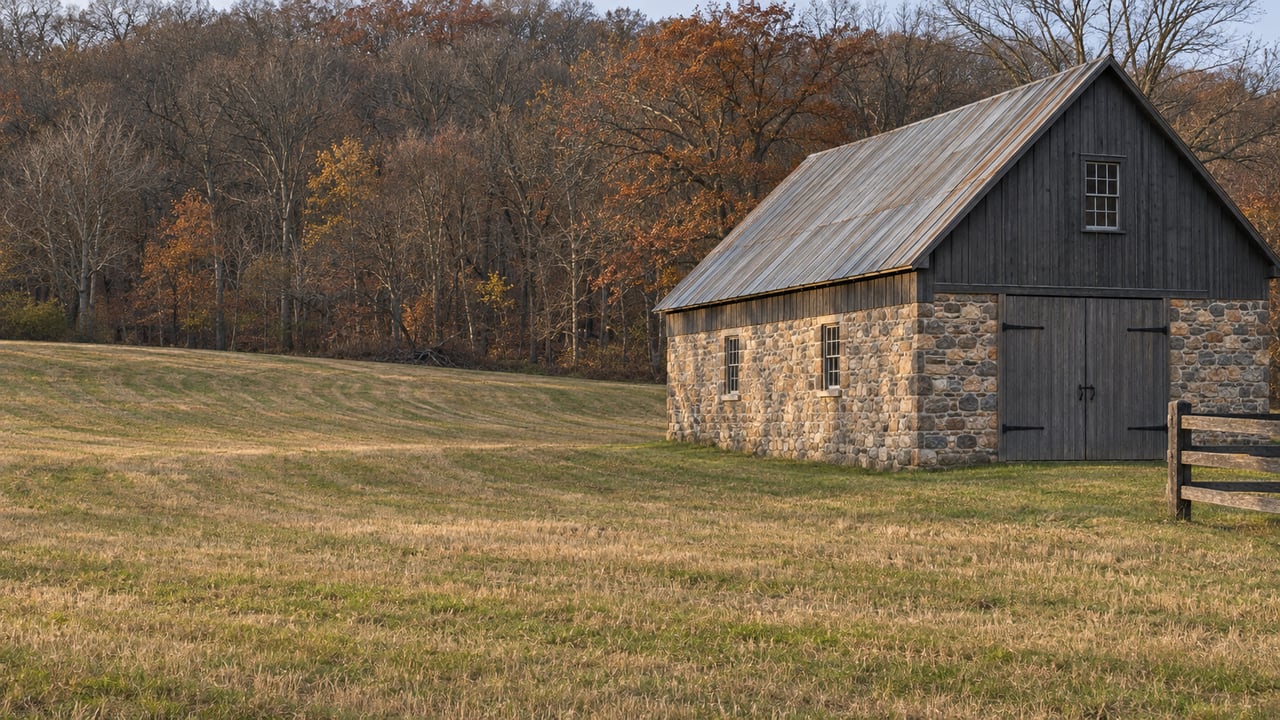
In October 2024, Alexandria Township's tax assessor inspected a small acreage property and took it off the farmland assessment list. The township committee's July 10, 2025 minutes say the assessor suggested a woodlot management or stewardship program as another route. The owners did not think that would work for them and appealed. The Hunterdon County Tax Board granted farmland assessment, even though the minutes describe the property as half an acre short of qualifying.
The township decided against taking the case to the state level, which the minutes describe as a trial and costly litigation. The same minutes note that the owners must file every year and that the assessor can deny the application each year if the criteria aren't met. That last line matters most to anyone buying acreage in Hunterdon County. The farmland-assessed tax figure on a listing reflects one owner's application and one owner's farming. It gets decided again every year, and from 2026 on it gets decided under stricter rules.
The Tax Bill on the Listing Sheet Comes From Last Year's Application
Farmland assessment is not a small niche in this county. The state's most recent county report, covering tax year 2024 and revised in July 2025, puts 111,892 Hunterdon acres under farmland assessment. That's about 40 percent of the county's land, spread across 3,420 approved FA-1 forms. The state warns that the form count is not the same as the number of farms, because one form doesn't always match one farm.
The New Jersey Department of Agriculture's farmland assessment page lists what a parcel needs:
- At least 5 contiguous acres in agricultural or horticultural use
- That use in place for at least two consecutive years before the tax year
- An application filed with the municipal tax assessor on or before August 1 of the pretax year
- Gross sales of at least $1,000 a year for the first 5 acres, plus $5 for each additional acre
- For woodland under a Woodland Management Plan, at least $500 for the first 5 acres plus 50 cents per additional acre
The farmhouse, and the land used with it, does not count toward the qualifying acreage. That means a listing described as 6 acres can come up short once the house lot is taken out.
Ownership changes on their own do not reset anything. Under N.J.A.C. 18:15-7.2, rollback liability attaches to the land when its use changes, and not when it changes hands, as long as the new owner keeps the land in qualifying agricultural or horticultural use. The buyer inherits the land's history and takes over the obligation to keep it going.
What Rollback Costs Is Set by a Formula
If the use changes, for example when hay fields become lawn or pasture goes unused, the regulation sets out how the assessor calculates rollback taxes for each year involved:
- Determine the land's true market value under the standard used for other taxable land in the town.
- Multiply that value by the county's common level ratio to get what the land assessment would have been.
- Subtract the farmland assessment actually used that year to find the additional assessment.
- Multiply that difference by the town's general tax rate for that year.
The calculation covers the year the use changed plus the two tax years before it in which the land was farmland-assessed. On a parcel that qualified in 2025 and 2026, a change of use in 2027 reaches back through all three years. That can include years when the seller still owned the land, because the liability follows the land. The regulation's case notes cite Paz v. DeSimone, a 1976 decision in which a buyer was held liable for rollback taxes after a change in use. How a specific contract handles rollback exposure is a question for the buyer's attorney.
The Hunterdon Numbers an Assessor Works From
The gap in step 3 is large because farmland is valued on what the soil produces, not on its sale price. The State Farmland Evaluation Committee's 2027 productivity values report, dated October 2026, sets these Hunterdon values per acre at a soil rating of 100:
| Land class | 2027 Hunterdon value per acre |
|---|---|
| Cropland harvested | $820 |
| Cropland pastured | $410 |
| Permanent pasture | $164 |
| Non-appurtenant woodland | $144 |
| Appurtenant woodland | $41 |
| Imputed grazing value, used for qualifying income | $220 |
The last row matters most to horse properties. The report says the imputed grazing figure is used to decide whether land qualifies, not to value it. The statute counts income imputed to pastured cropland and permanent pasture used for grazing toward the gross-sales test. It also counts fees for boarding, rehabilitating or training livestock when those facilities sit next to land that otherwise qualifies. How the paddocks are used and documented can decide whether a horse farm qualifies.
The NJDA Soil Productivity Mapping Tool, built with Rutgers, pulls soils reports by tax parcel. It shows which land counts as cropland harvested, cropland pastured, permanent pasture, woodland, or land attached to the farmhouse that is not assessed as farmland.
The 2026 Law Arrives in a New Owner's First Filings
Governor Murphy signed the Farmland and Woodland Tax Assessment Integrity and Investment Act, P.L.2025, c.274, on January 14, 2026, after a 37–0 Senate vote and a 70–1–2 Assembly vote. The enacted text took effect immediately. Here is how its pieces line up for someone closing on Hunterdon acreage this winter:
- Inspections. The assessor's review now has to include an on-site inspection of the land at least once every three years. The municipality may charge up to $25, and parcels with the same owner pay a single fee. The Alexandria case began with an inspection like this, before the law made them mandatory.
- Penalties. Civil penalties for gross and intentional misrepresentation on an application rise to as much as $5,000 for a first offense, $15,000 for a second, and $20,000 for a third or later offense.
- The portal. Online filing replaces paper FA-1, gross sales and WD-1 forms. The 2026 soft launch was open only to Camden, Cape May, Mercer and Somerset, so Hunterdon applicants used paper forms from their local assessors this year. The state plans to put every county on the portal in 2027. A buyer filing for the first time by August 1, 2027 will likely be among the first Hunterdon owners to file through it.
- The income floor. In August 2025 the Farmland Evaluation Committee voted to recommend raising the first-five-acre minimum from $1,000 to $1,900. According to the minutes, the $1,000 figure was last adjusted in 2013. The new law says an adjustment takes effect in the second full tax year after the rule is adopted. The committee's August 12, 2026 minutes describe the threshold as rising effective 2028/2029.
Those are the same tax years a buyer closing now would be filing for. A small hobby operation that clears $1,000 today on its first five acres would need to show almost twice as much once the new floor applies, and an inspector will be checking the land in person.
What a Seller Can Hand Over
Since every owner earns the status again each year, the most useful thing a seller of a farmland-assessed parcel can provide is the record behind it. That means the filed FA-1 forms, the gross sales records, any woodland management plan, and an outline of who works the land and on what terms. A buyer can compare that record with the soils map and the figures above before the inspection period ends.
For wooded parcels, the New Jersey Forest Service's Forest Stewardship Program is another route to reduced property taxes. It requires an approved 10-year plan on at least five forested acres. Under the enacted law, a property with a DEP-approved forest stewardship plan does not have to produce income if the plan is fully carried out and the parcel otherwise qualifies. The Forest Service reviews woodland plans and inspects sites at least every three years, and the municipal assessor still makes the final call on qualification.
Help is available locally. The Agriculture and Natural Resources department at Rutgers Cooperative Extension of Hunterdon County offers agricultural education and soil-testing guidance. The Hunterdon County Board of Agriculture is an advocacy and support organization for county farmers. The NJDA says questions about a specific parcel's farmland assessment go to the municipal tax assessor.
Quick Answers
Does buying a farmland-assessed property trigger rollback taxes? Not by itself. Under N.J.A.C. 18:15-7.2, rollback applies when the use changes, not when the owner changes, provided the new owner keeps the land in qualifying use.
If the assessor denies an application, is that the end of it? In Alexandria, the owners appealed to the Hunterdon County Tax Board and won, and the township chose not to go further. The minutes still note that the assessor can deny the application again in any later year.
Is the $1,900 threshold in effect now? No. The current floor is $1,000 for the first five acres, and the committee describes the increase as effective 2028/2029.
This post is general information, not legal, tax or financial advice. Confirm how these rules apply to your own parcel with your municipal tax assessor, an attorney, or a tax professional.
If you're weighing a Hunterdon property with acreage, pasture or woodland and want to understand its farmland assessment record before you commit, Freeman Smith can help you put the right questions to the seller and the assessor while there's still time in the contract. Let's Connect.